
Sooji ka halwa is a classic Indian dessert made with fine semolina, ghee, and sugar, flavored with cardamom and saffron. This easy sooji halwa recipe comes together with just 3 ingredients in under 20 minutes, and it's make-ahead and freezer-friendly.
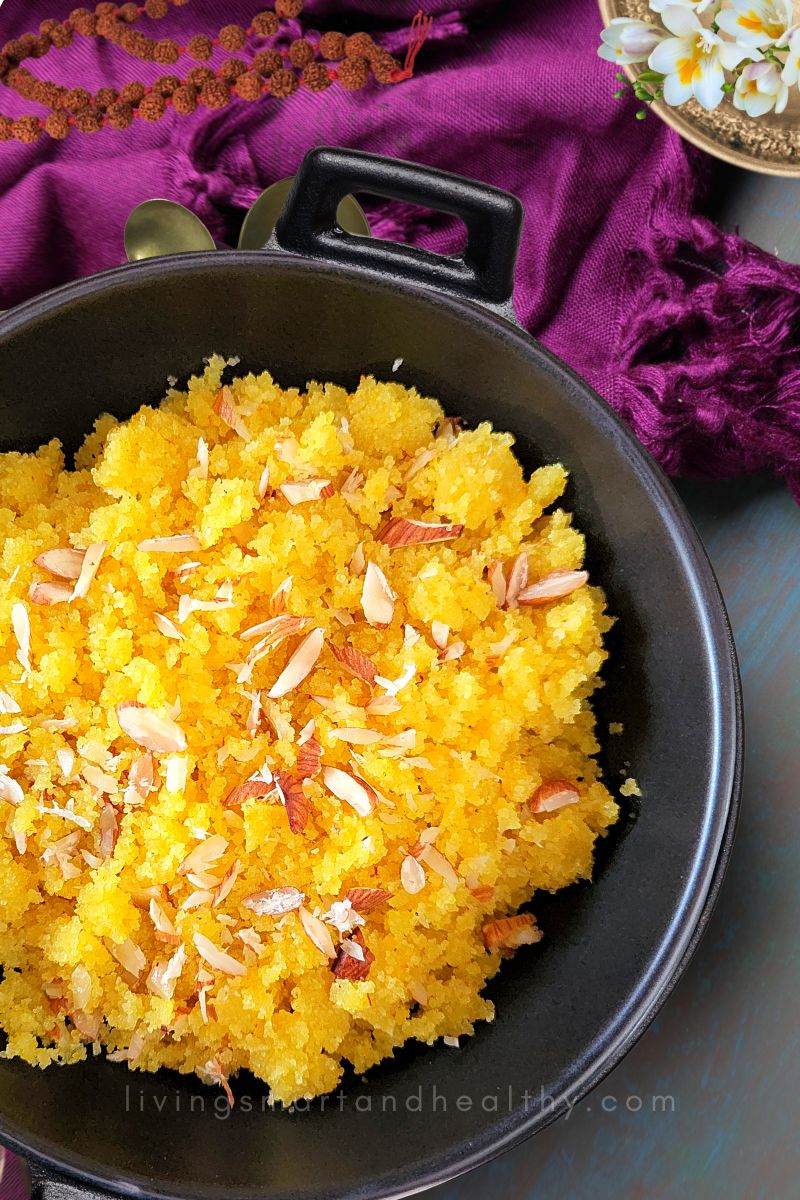
You will love this sooji halwa. It's easy to make, comes together in under 20 minutes, and is infused with a lovely, mild floral saffron flavor, warm cardamom, and the crunch of toasted almonds, a must-try if you love Indian sweets.
Sooji halwa and kheer are my go-to recipes for festivals, my bhog thali or prasad isn't complete without them. Today I'm sharing my easy version of this classic halwa made with just 3 simple ingredients.
Love Indian sweets? Check out Badam Katli, Coconut Burfi, Mango Shrikhand, Mango Phirni, and No Fry Gujiya.
Jump to:
Why You'll Love This Recipe
- Just 3 main ingredients - sooji, ghee, and sugar (saffron, cardamom, and coconut are optional flavor add-ons).
- Ready in 20 minutes, start to finish - no soaking, no waiting.
- Make-ahead and freezer-friendly - keeps up to 2 weeks refrigerated or 2 months frozen.
- Naturally vegetarian, and easy to make vegan or dairy-free (swap the ghee for oil).
- Foolproof texture - the exact roasting time and syrup temperature below guarantee a grainy, never-mushy halwa every time.
What Is Sooji Halwa
Sooji halwa is a popular Indian dessert made from roasted semolina (sooji, also called suji or rava), ghee, and sugar syrup, flavored with cardamom and saffron. It's traditionally offered as bhog or prasad, a food offering to God and made for special occasions like weddings, pujas, and festivals such as Diwali and Navratri.
The same dessert goes by different names across India: in North India it's sooji ka halwa, in Maharashtra it's called sheera or rava sheera, and in South India it's known as kesari bath. There are regional variations too, my mom used to make gur ka halwa (jaggery halwa), especially in winter.
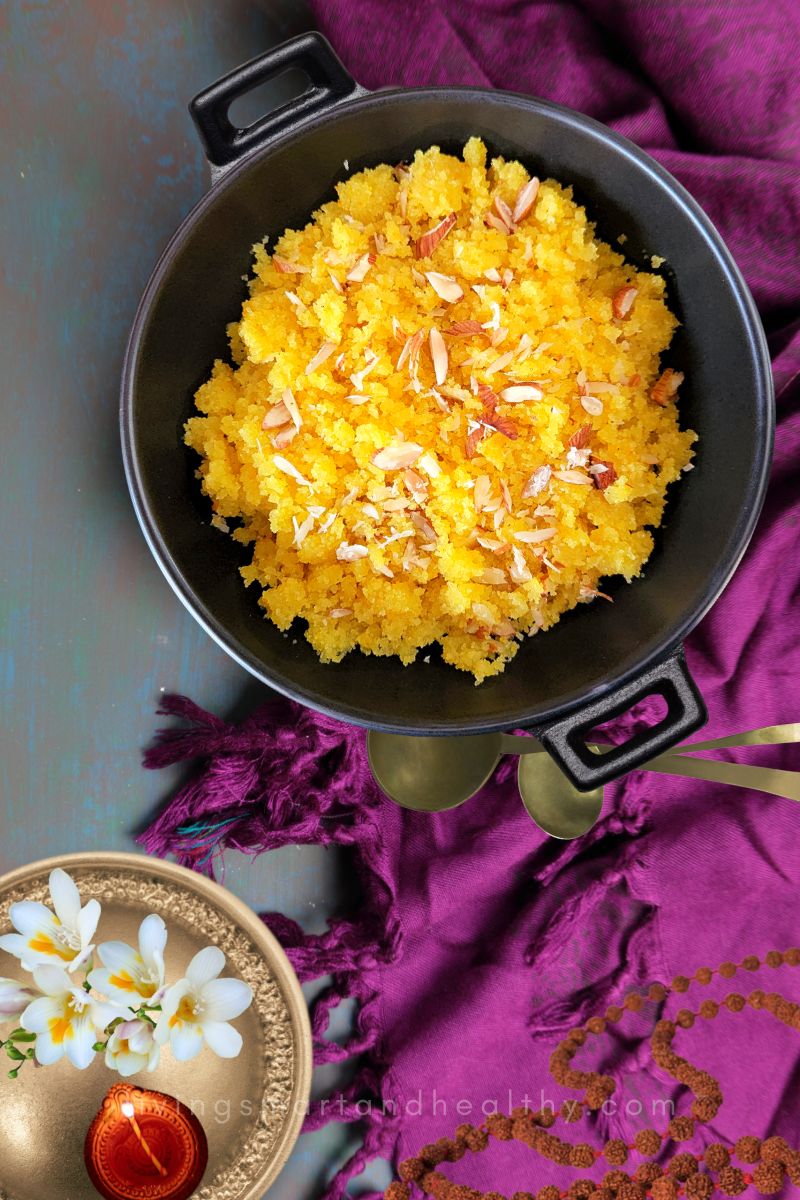
Ingredients For Sooji Halwa Recipe
- 1 cup fine sooji (semolina/rava)
- 2 tablespoon desiccated coconut powder (optional)
- ¾ cup ghee
- ¾ cup organic sugar
- 2 cups water
- pinch of saffron strands (optional)
- 3-4 whole green cardamom pods
A note on ingredients: Use fine sooji, not the coarse/bansi variety used for upma, fine sooji gives this halwa its smooth, melt-in-the-mouth texture. Ghee is traditional and gives the best flavor and that signature glossy sheen, but you can substitute a neutral oil or coconut oil for a dairy-free version. Saffron and cardamom are both optional and independent, use one, both, or neither depending on the flavor you want.
How To Make Sooji Ka Halwa
Step 1: Prep For Halwa
Using a mortar and pestle, grind the cardamom seeds to a fine powder. Note: Save the cardamom shell and use it to make a cup of chai.
In the same mortar, add a pinch of saffron and a pinch of sugar and grind the saffron to a fine powder.
Step 2: Make The Syrup
In a pan, combine water and sugar. Stirring continuously, bring the mixture to a boil. Once the sugar has dissolved completely, remove the pan from the heat.
Add the cardamom powder and saffron powder, mix well, and set the sugar syrup aside.
Step 3: Make The Halwa
In a cast iron kadai or a heavy-bottomed pan, melt the ghee.
Optional: Add nuts and fry for a few seconds until light golden. Remove the nuts and set them aside.
Add the sooji and roast over medium-low heat for 8-10 minutes, until fragrant. Note: The sooji does not change color, it only turns aromatic.
Optional: Add the desiccated coconut powder and roast for 1-2 minutes more.
Gradually add the sugar syrup, stirring constantly to avoid lumps. Note: Add the syrup slowly, the mixture bubbles vigorously when the syrup goes in.
Keep stirring the sooji until all the syrup is absorbed.
The sooji will absorb the syrup, thicken, and start to leave the sides of the pan. Reduce the heat to the lowest setting, cover the pan, and simmer for 5 minutes. Turn off the heat.
Garnish with roasted nuts and serve warm.
Tips For The Best Halwa
Roast the sooji well
The sooji must be roasted well. It won't change color much, it swells up and gives off a nutty aroma when it's ready. I prefer to keep mine pale; for a deeper brown color, roast slightly longer. Always roast on medium-low heat and stir frequently to avoid uneven roasting, this step takes patience, so don't rush it.
Match the temperature of the sugar syrup
The syrup and the sooji should be roughly the same temperature when combined. Make sure the sugar syrup is hot when you add it.
Stir continuously to avoid lumps
Sooji absorbs sugar syrup very quickly, so stir constantly as you pour it in and add it slowly, since the mixture bubbles up a lot.
Multitask on two burners
Make the sugar syrup on one burner while roasting the sooji on another. This saves time and keeps both hot when it's time to combine them.
How to grind saffron
Grind a pinch of saffron with a pinch of sugar using a mortar and pestle, it powders beautifully. Alternatively, soak the saffron in 1 tablespoon of warm milk for 5-10 minutes, then use that saffron milk in the halwa.
Skip powdered sugar
Don't substitute powdered sugar, it gives an undesirable taste and texture.
Use fresh cardamom pods
Freshly ground cardamom powder (rather than store-bought) gives noticeably better flavor.
Use a heavy-bottomed pan
A cast iron kadai or any heavy-bottomed pan prevents scorching and roasts the sooji more evenly.
What To Serve With Sooji Halwa
Sooji halwa is delicious on its own, but it's traditionally served alongside poori and chana (chickpea curry) as a festive breakfast, this combination is often called halwa puri. It also makes a lovely dessert after a North Indian thali, or a sweet offering (prasad) alongside other festival dishes.
Frequently Asked Questions
Use fine sooji for this halwa. Make sure it's fresh, sooji that has gone bad smells rancid, may have tiny white insects, or forms clumps. Discard it if you notice any of these signs.
Yes, you can scale this recipe up or down, simply halve or double all the ingredients.
I use organic sugar here, but feel free to use your preferred sweetener, brown sugar, jaggery, or another option all work. Make the syrup the same way; if using jaggery, dissolve it first, then strain it to remove impurities before bringing the syrup to a boil.
I use ¾ cup sugar, which I find well balanced. Adjust to taste, you can always taste the halwa partway through and add a little more sugar if needed.
Traditionally, sooji halwa is made with water. You can also use milk, or half water and half milk, for a creamier result.
I use saffron and green cardamom, which together give a mild floral, aromatic flavor. Use one or both. Nutmeg and cinnamon also work well as flavoring, but avoid pairing them with saffron since their flavors clash. Rose water or rose essence paired with cardamom is another great combination.
Yes, saffron adds a pale yellow color and mild floral flavor, but it's easy to skip. Cardamom alone works beautifully.
It's not traditional, but I like adding it for extra flavor and a lovely coconutty aroma.
I find 1 cup sooji to ¾ cup ghee gives the best texture, halwa should stay slightly grainy even after cooking. You can use half ghee and half oil (like coconut oil or another neutral oil) if you prefer.
Skip the ghee and use coconut oil or another neutral cooking oil in its place.
Once the mixture thickens and starts to leave the sides of the pan, reduce the heat and simmer for just a few minutes. Overcooking at this stage makes the sooji lose its grainy texture and turn mushy.
This means the sooji wasn't roasted long enough. Roast it until it's fully aromatic before adding the syrup.
Yes, almonds, cashews, raisins, charoli, and pistachios all add great crunch and flavor. Use whichever you like.
Yes. It stays fresh in the refrigerator for up to 2 weeks in an airtight container, or in the freezer for up to 2 months.
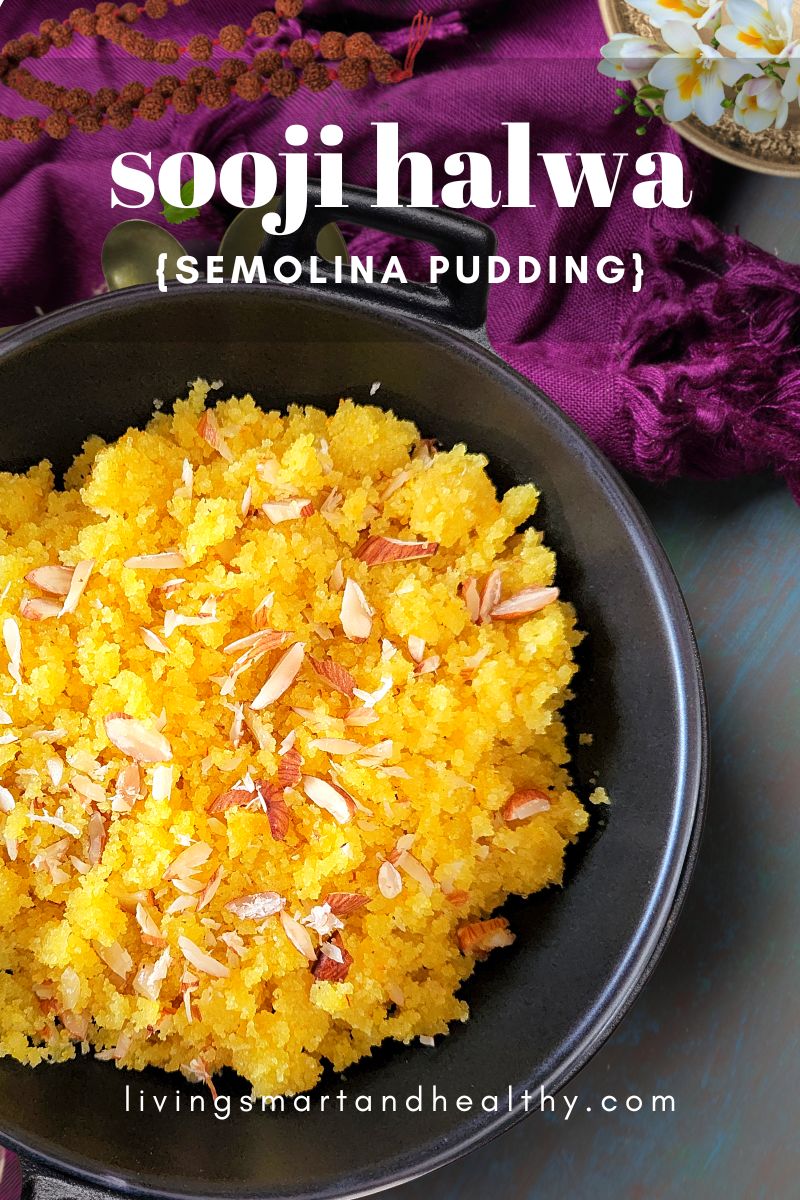
How To Store The Halwa
Store the sooji halwa in an air-tight container in the refrigerator for up to 2 weeks.
You can freeze the halwa for up to 2 months in the freezer. Store it in a freezer-safe container or Ziploc bag. Thaw it in the refrigerator or kitchen counter and enjoy the halwa.
More Indian Desserts
- Gajar Ka Halwa Recipe (Instant Pot Carrot Halwa)
- Sweet Potato Halwa (Shakarkandi Halwa)
- Instant Pot Gajar Halwa (No-Grate Carrot Halwa)
- Lauki Halwa Recipe (Dudhi Halwa)
Sooji Halwa Recipe (Suji Ka Halwa)
Equipment
Ingredients
Ingredients For Sooji Halwa Recipe
- 1 cup fine sooji
- 2 tablespoon desiccated coconut powder (optional)
- ¾ cup ghee
- ¾ cup organic sugar
- 2 cups water
- pinch saffron strands (optional)
- 3-4 whole green cardamom
Instructions
How To Make Sooji Ka Halwa
Step 1: Prep For Halwa
- Using a mortar and pestle, grind the cardamom seeds to a fine powder.Note: Save the cardamom shell and use it to make a cup of chai.
- In the same mortar, add a pinch of saffron and a pinch of sugar and grind the saffron to a fine powder.
Step 2: For The Syrup
- In a pan, combine water, and sugar. Stirring continuously bring the mixture to a boil. Once the sugar has dissolved completely, remove the pan from the heat.
- Add cardamom powder and saffron powder, and mix well. Set the sugar syrup aside.
Step 3: For The Halwa
- In a cast iron Kadai or a heavy bottom pan, melt ghee.
- Optional: Add nuts and fry for a few seconds to a light golden color. Remove nuts and set them aside.
- Add sooji and roast it over medium-low heat for 8-10 minutes or it turns fragrant.Note: The sooji does not change color, only turns aromatic.
- Optional: Next, add desiccated coconut powder and roast for 1-2 minutes.
- Now gradually, add the sugar syrup, and keep stirring to avoid lumps.Note: Be careful, add the syrup slowly. The mixture bubbles a lot when sugar syrup is added.
- Continue stirring the sooji till all the syrup has been absorbed.
- Sooji will absorb all the syrup and start to thicken and leave the sides of the pan. Reduce the heat to the lowest setting and cover the pan. Simmer the halwa for 5 minutes. After 5 minutes turn OFF the heat.
- Garnish with roasted nuts and serve warm sooji halwa!
Notes
Nutrition
Disclaimer
Nutrition values are my best estimates. If you rely on them for your diet, use your preferred nutrition calculator.



Sneha R says
Made this for Navratri prasad and it came out perfectly, thank you for the tip about matching the syrup temperature to the sooji, that made all the difference!
Jyoti Behrani says
So happy to hear that! The temperature-matching trick really is the secret to avoiding lumps. Thanks so much for trying the recipe and for the sweet comment!
Anita S says
Can I use this same method with jaggery instead of sugar? Want to try the gur wala halwa you mentioned.
Jyoti Behrani says
Yes, absolutely! Dissolve the jaggery in the water first, then strain it to remove any impurities before bringing it to a boil, and follow the rest of the recipe the same way. It gives the halwa a lovely deep, caramel-like flavor, my mom's version!
Sneha R says
This was my first time making halwa and it turned out so well! Quick question, can I make it ahead for a dinner party?
Jyoti Behrani says
so glad it turned out great! Yes, it keeps beautifully in the fridge for up to a week, so you can absolutely make it ahead. Just warm it up before serving.